




Having spent Easter in France driving around with commercial radio on, I was frequently roused from my passenger seat slumber by the squawking of a bird imploring me to consume beer.
Apparently, Heineken own the Pelican brewery https://www.heinekenfrance.fr/nos-marques/nos-bieres/pelican/ and that’s the way they choose to advertise their wares. Each to their own.
Evidently, the mind worm took hold, for it encouraged me to get stuck into the judgment of Salts Healthcare Ltd v Pelican Healthcare Ltd [2025] EWHC 497 (Pat). The case concerned a patent dispute over ostomy appliances, specifically the design of ostomy bags. Salts Healthcare owned UK Patent GB2569212, which described ostomy bags with specific weld features. Pelican Healthcare marketed the “ModaVi” ostomy bag, which Salts claimed infringed several claims of their patent (claims 5, 8, and 20).
What’s interesting about the case is that it represents another real world use of the Actavis v Lilly [2017] UKSC 48 test for the assessment of equivalence infringement in UK law, which has been developing for almost a decade now, and has some practical considerations for patent attorneys.
Infringement in the UK
First, a recap on normal infringement vs equivalents infringement:
- The law on infringement on a normal interpretation of the claims is described in Terrell, 20th at 9.14-9.37. The claims are considered purposively and not literally.
Something that can be quite difficult to grasp outside of the IP industry is that the ‘normal’ interpretation of claims is not the same as the ‘literal’ interpretation of claims. Words in a claim don’t necessarily have their dictionary definition, but for the assessment of claim scope, are determined purposively. In other words, what was the author trying to achieve with their words, since their intent would have been to write a valid and useful patent from the outset.
- The principles of infringement by equivalents are set out in the decision of the Supreme Court in Actavis vLilly [2017] UKSC 48:
- “(i) Notwithstanding that it is not within the literal meaning of the relevant claim(s) of the patent, does the variant achieve substantially the same result in substantially the same way as the invention, i.e. the inventive concept revealed by the patent?
- (ii) Would it be obvious to the person skilled in the art, reading the patent at the priority date, but knowing that the variant achieves substantially the same result as the invention, that it does so in substantially the same way as the invention?
- (iii) Would such a reader of the patent have concluded that the patentee nonetheless intended that strict compliance with the literal meaning of the relevant claim(s) of the patent was an essential requirement of the invention?
- In order to establish infringement in a case where there is no literal infringement, a patentee would have to establish that the answer to the first two questions was ‘yes’ and that the answer to the third question was ‘no’.”
Even if normal infringement cannot be determined, then there is an assessment made as to whether a variant would achieve the same end result, and therefore whether that equivalent would fall within the scope of the claim.
Back to the patent
Construction of the claims focussed on what constituted ‘peripheral welds’ in GB2569212.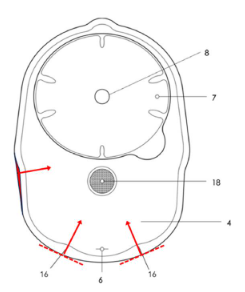
To cut a long story short, Pelican’s arguments about the slopes of the peripheral welds of the ostomy bag were successful enough to generate a non-infringement defence under normal interpretation.
The more interesting aspect of the judgment arrives on the consideration of equivalence.
In the first modified Improver question outlined in Actavis v Lilly [2017] UKSC 48, the inventive concept of the patent needs to be characterised. Both Salts and Pelican put forward their own interpretation of the inventive concept, to further their arguments.
The judge, Mr Ian Karet, makes some interesting asides when considering what the inventive concept of GB2569212 is.
Each of the 32 claims is to an appliance, and ten of them are independent. Some claims are for a colostomy appliances and others for colostomy or ileostomy appliances, and some are for “drainable ostomy” appliances. As I have said, the performance of all these appliances is relative to some unspecified version of a bag. This makes the concept hard to distil.
Salts introduced a large number of different possible embodiments into their application, which were covered by various non-overlapping independent claims. At trial, the judge found it hard to identify the core inventive concept of the patent, and this has a knock-on effect on the conclusions for equivalence.
The third question asks whether such a reader of the patent would have concluded that the patentee nonetheless intended that strict compliance with the literal meaning of the relevant claim(s) of the patent was an essential requirement of the invention? In this case the answer is ‘yes’ for the bag as a whole and for the waist and the lobes considered separately. The invention can be achieved in a number of ways, for example, as Salts put it in closing, by making a narrower bag. In this case the patentee has chosen a particular way in which to achieve the intended effect and has limited the claims to the specific structures claimed. The Patent describes a set of appliances that have particular features. It would, for example, have been straightforward for the patentee to formulate a claim by result or to a ‘narrower’ bag or to omit the word ‘downwardly’, but none of the asserted claims does that. The claims are limited to appliances with the particular structures claimed and strict compliance is intended.
The problem with the rather nebulous definition of the inventive concept in the patent as filed is that the judge has been forced to look at the literal language of the claims in more detail. That Salts wrote the patent in a way that can be interpreted as having a very broadly cast inventive concept but with consistent and narrow limitations in the claims has proven their downfall. The strict compliance with the literal wording of the claims is enforced within the third strand of the modified Improver questions, and thus the equivalence argument failed.
A warning to practitioners
Herein lies the trap. There is a strategic desire to put into patent applications lots of what I term ‘smearing’ – wording that can be used to assist an applicant if the concept changes over time. It is inevitable that a prototype product that may be ready when the patent application is filed will be modified before commercial launch, and it is desirable to have some flexibility in the patent application to accommodate modifications.
That is eminently within the skillset of a patent attorney to achieve. However, there remains a tightrope act to walk; ultimately, if the inventive concept is ill-defined, or is deliberately left vague in an effort to give more room to an equivalence argument during infringement, this can have the complete opposite effect. Salts v Pelican clearly shows this, in that the unstructured definition of the inventive concept has caused the failure to prove infringement by equivalents as strict compliance with the literal wording of the claim was deemed necessary.
In the end, there is no serious change to practice emanating from this judgment. The conclusion merely emphasizes that one must always be clear and precise in defining what the invention is in a patent if you want it to stand up to scrutiny during enforcement.
If you have any patent, design or trade mark queries, please contact us via email, by telephone: +44 (0) 1242 691 801, or using the form below and we will be happy to advise and guide you.
Author