




To make it less costly for individuals and small companies to file a European patent application, the European Patent Office (EPO) is discounting some of its official fees. Despite Brexit, the UK remains part of the European patent system, so this is good news for patentees seeking protection in the UK as well as in mainland Europe.
The European Patent Office made the following recent statement:
“Fees for European patent applications are changing from 1 April 2024. These include reductions for small companies and even the abolition of some fees. Internal renewal fees are rising by less than the rate of inflation resulting in a decrease since 2016 in absolute terms.”
Rejoice! The European Patent Office is levelling the playing field for micro-enterprises – the cost of the European patent is coming down not for the billionaires of the world, but for you, the little guy.
Let’s have a look at the headline facts, as these changes kick in on 1 April 2024:
- New Rule 7a EPC – micro entity fee reductions!
If you are a microenterprise, a natural person, or a non-profit organization, then you’re entitled to a 30% reduction in the following official fees for a European patent application:
-
- Filing fee;
- Search fee;
- Examination fee;
- Designation fee;
- Grant and printing fee; and
- Renewal fees.
Fantastic! Sure, the reductions are less generous than those handed out by the USPTO, but beggars can’t be choosers. It’s a step in the right direction to allow smaller businesses to reduce the cost of applying for a European patent.
- What’s a microenterprise?
Who decides who is eligible for micro status? Brussels, of course! An micro enterprise by definition has:
-
- Fewer than 10 employees; and
- An annual turnover or balance sheet of less than 2 million Euros.
Notably, this isn’t restricted to European entities, so microenterprises from West Philadelphia to Bel Air and beyond will be able to take advantage of the fee reductions.
- Don’t get carried away…
The banner message the EPO want you to look at is that micro entities are getting a leg up. But let’s look at some of the other new rules:
-
- The reduction of fees referred to in paragraph 3 shall not be available where the same person has filed five or more European patent applications or Euro-PCT applications within a period of five years preceding the date of filing of the European patent application concerned.
Got a lot of ideas? Bad luck – you file too many patent applications and your discount goes out the window.
-
- Applicants wishing to benefit from a reduction of fees shall declare themselves to be a person within the meaning of Rule 7a.
- Should it become apparent that an incorrect declaration has been filed or the European Patent Office has not been informed of a change of status in accordance with paragraph 2 and a reduced payment is made, the fee shall be deemed not to have been paid and the application shall be deemed to be withdrawn.
You need to make a declaration that you are eligible for the discount. Declare incorrectly – that’s grounds for loss of the application. Sure, further processing and/or re-establishment of the application would be available, but there are penalty fees involved.
Under the surface, there’s a big mitigating factor at play.
In order to ensure the Organisation’s financial sustainability, moderate fee increases will be implemented to offset at least partially the high inflation and reduced income resulting from the EPO’s gains in timeliness. European Patent Office
Official fees have increased for the third successive year at the EPO. Traditionally, EPO fee alterations were made every other year.
The fee increases in 2020 were around 4% on average. The fee increases in 2022 were around 3% across the board. The fee increases in 2023 were around 5%. This year, the fee increase is around 4% average, but, the third and fourth year renewal fees have been increased by approximately 30%.
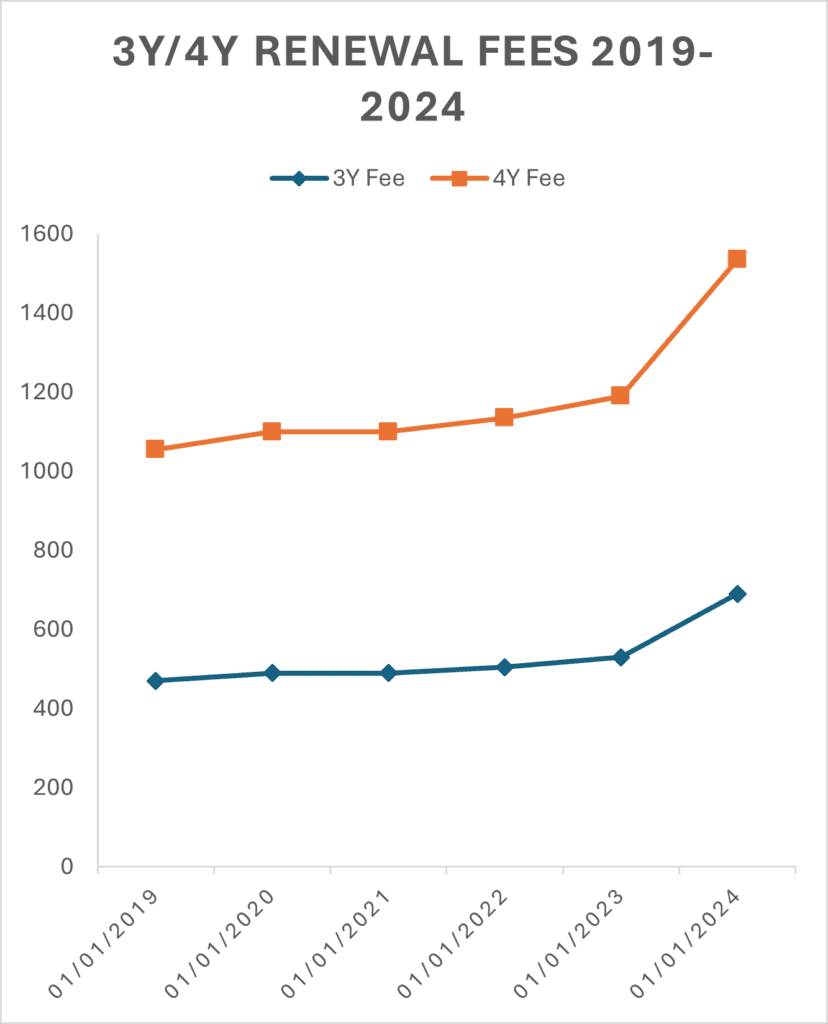
Comparison of the change in price of the third and fourth year renewal fees for a European patent application, from 2019 to 2024.
It’s worth comparing this to the USPTO. There were fee increases in October 2020, and there are forthcoming increases for 2025, which amount to around 10% for search and examination fees for utility patents.
In terms of the fees payable by an applicant, a European patent is considerably more expensive than a US patent, and the direction of travel appears to make this difference more stark. It’s hard to escape the conclusion that the EPO is using the micro discounts as a fig leaf to cover the price hikes, which are almost certainly a consequence of the introduction of the Unitary patent system. So much for reducing complexity and lowering costs.
Still, if you are eligible for the discounts, it is probably worth holding off until 1 April 2024, if you can, to file a European patent application or European regional phase application, as the discounts will largely offset the price rises.
Bad luck if you don’t meet the criteria. However, if you:
-
- Have fewer than ten employees;
- Have an annual turnover or balance sheet of less than 2 million Euros; and
- Have not filed more than five European patent applications in the preceding five years,
then you should find that, from 1 April 2024, the cost of the European patent application becomes much less than now. This might make the European patent application far more cost-effective for micro entities.

ASK AN ATTORNEY
Author