




Two recent first instance decisions on infringement from the Unified Patent Court (UPC) discussed the Gillette defence. So, is the Gillette defence going to be a razor-sharp strategy for potential infringers at the UPC, or has its effectiveness been blunted?
What is the Gillette defence?
The Gillette defence is a well-known defence against infringement in UK patent litigation. It stems from a 1913 House of Lords case: Gillette Safety Razor Co. v. Anglo-American Trading Co.
The Gillette defence is powerful because it is rooted in a simple but fundamental truth of patent law: a valid patent cannot protect something which was public at the filing/priority date of the patent.
A patentee can perform all the linguistic gymnastics they wish on how the wording of the claims should be interpreted to cover the potentially infringing product or method. However, if the product or method is more-or-less the same as what was public at the filing/priority date, the Gillette defence will deflect the patentee’s arguments.
A successful Gillette defence puts the patentee in a “squeeze” or “Catch-22”; either:
- For a finding of infringement, the claims are construed to cover the potentially infringing product – but this means that the claims read onto the prior art and so the patent is invalid; or
- To make the patent valid by circumventing the prior art, the claims are construed to not cover the potentially infringing product – but this means that there is no infringement.
The patentee loses whichever way is chosen; either there is no infringement, or the patent is invalid.
Why might the Gillette defence be relevant for the UPC?
One might wonder why a more than century old UK legal defence is relevant for the brand new UPC, a central forum for patent litigation for European patents in some EU countries.
After all, due to Brexit, the UK is not a part of the UPC (although European patents still cover the UK, and UK-based attorneys can still be European patent attorneys and so generally have right of representation at the UPC).
The answer lies in the Gillette defence’s power to stop patent claims from being construed overly broadly. It provides an effective check on the power of the doctrine of equivalents, which can broaden a patent claim well beyond any normal reading of the claim wording.
The recently established UPC is forming its case law, including on the doctrine of equivalents. Its litigants and judges therefore look to influential patent law jurisdictions, such as the UK, in an effort to shape the UPC’s case law and determine its limits on the doctrine of equivalents.
“No room” at the UPC for the Gillette defence?
The first of the two recent decisions from the UPC considering the Gillette defence was that of SodaStream Industries Ltd. v. Aarke AB.
SodaStream was alleging infringement of its European patent EP 1793917 (EP’917) by Aarke’s sale of the Carbonator Pro in various UPC territories.
The invention of EP’917 is directed to a carbonator which has a safety feature in case a glass bottle which is being filled explodes under pressure. The carbonator defines a locked and closed container for the glass bottle, so that flying glass particles can be contained. SodaStream alleged that Aarke’s Carbonator Pro had the same features.
Aarke invoked the name of the Gillette defence, arguing that the claims of EP’917 could not cover its Carbonator Pro since it is more or less the same as two products published before the priority date of EP’917 in US patent 4,323,090 and US patent 4,342,710.
Superficially, the Carbonator Pro probably does look closer to the inventions of the two older US patent documents than it does to the embodiment of SodaStream’s EP’917.
Aarke’s Carbonator Pro and each US patent use a tube-like shield around the filling head which descends to a drip tray to cover the glass bottle. EP’917 instead uses a “flask” in which you put the glass bottle and then the filling head connects to the flask.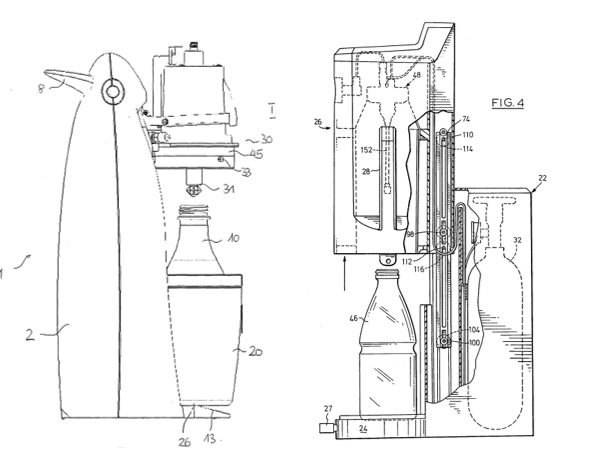
Embodiment of EP’917 – glass bottle 10 placed in flask 20 vs US4323090 – shield descends to drip tray, in a similar way to Aarke’s Carbonator Pro
Therefore, it seems a reasonable decision at first appearances by Aarke’s representatives to use the Gillette defence.
However, in their written decision, the panel of judges for this case said that there was “no room” for the Gillette defence in their decision.
While it may seem that this means that the Gillette defence is not applicable at the UPC, in fact it is not so clear cut.
The judges used the principle of the Gillette defence in construing the claims, making sure that their interpretation was clearly distinguished from the prior US patents.
The reason Aarke’s use of the Gillette defence fell down is more likely to do with it not being appropriate for the case, rather than the Gillette defence not being in accordance with the principles of the UPC. Aarke’s Carbonator Pro was not actually like the US prior patents – at least not in the way that mattered.
In Aarke’s Carbonator Pro the shield locks into the drip tray, with the court finding that this would prevent glass particles from escaping. It is this locking which is much the same as the invention of EP’917, where the flask and the filling head lock together. In contrast, in the prior US patents there was a potential gap through which damaging glass particles could escape. Therefore, Aarke’s Carbonator Pro was not conceptually the same as the prior US patents, and so the Gillette defence was not applicable.
Interestingly, Aarke did not actually use the Gillette defence fully, since they did not file for revocation of EP’917. They did not seem to consider EP’917 to be invalid in view of the US patents. Since you cannot squeeze a patent from one side only, the Gillette defence was therefore not the strategy to use in this case. More attention should have gone into convincing the judges that the Carbonator Pro did not obviate the risk of flying glass particles – although perhaps that would have been commercially undesirable for Aarke.
So, whilst the Gillette defence was rejected in this case at the UPC, that does not mean that it will be in others, especially in those in which the facts support its use.
How far UPC judges will use prior art in order to construe the claims of a European patent, or influence its breadth of protection under the doctrine of equivalents, as needed by the Gillette defence, remains to be seen. In this case, the judges did use the prior art to interpret the claims, but they noted that they were required to do this, since the US patents were cited in the background of EP’917 itself. It will be interesting to see in future cases whether prior art which has not been cited in the patent itself could be used in the same way.
Doctrine of Equivalents
Arkyne Technologies S.L. v. Plant-e Knowledge B.V. is the second recent decision from the UPC which discussed the Gillette defence.
Here, the Gillette defence was merely mentioned by the judges, and did not form a major part of proceedings.
It arose in the casting of the questions for determining infringement under the doctrine of equivalents. The fourth and final question which needs to be answered “yes” in order to find infringement via equivalence is:
“Is the allegedly infringing product novel and inventive over the prior art? (i.e. no successful Gillette/Formstein defence)”.
The Formstein defence is the Gillette defence’s German cousin, and is to inventiveness/obviousness what the Gillette defence is to novelty.
Since, in this case, there was no question over the validity of the patent (once an issue with regards to priority was settled), there was no discussion of the Gillette defence. However, it is interesting to see that, at least for the court of first instance which issued this decision, there is apparently a place for UK case law at the UPC.
Conclusion
The Gillette defence is a useful check to prevent illogical overextension of the doctrine of equivalents, and for that reason seems set to play a part in UPC litigation. The defence’s UK origins does not seem to be a bar to its application, at least not at present. However, it is important to ensure that the defence’s application suits the facts of the case.
If you have a patent infringement matter you would like to discuss, please do not hesitate to contact us on 01242 691 801.
Author