double_arrow
Article Archive

double_arrow Ask an Expert

reCAPTCHA

What Our Customers Say...

5.0
Based on 101 reviews
powered by Google
26dragon76 profile picture
26dragon76
15:31 23 Jul 25
A truly exceptional experience – thank you Albright IP!

I want to personally thank Charlie Heal , Emily Fox, Cara McAtee, and the entire team at Albright IP for their hard work, dedication, and professionalism in helping me submit my first ever patent: the Baffer Ball fire suppression system.

From the very first meeting, Charlie and Emily made everything feel clear, comfortable, and respectful. They listened carefully to my ideas, even though I’m not from a technical or legal background – I’m a painter and decorator by trade. But they believed in my vision and treated it with such care and seriousness that I felt truly supported as an inventor.

Over several months, we worked closely by email and phone. Charlie and the team guided me step by step to build one of the strongest, clearest, and most professional patent drafts I could have hoped for. The claims they wrote are powerful, and the language used shows how deeply they understood my invention. They didn’t just file a document – they helped shape a legacy.

Charlie, even though he is young, is incredibly professional and experienced. I am amazed at how he managed such a complex project with kindness, patience, and precision. Emily and Cara were also fantastic throughout.

This was not just paperwork – this was my dream since childhood. And Albright IP helped me make that dream real.

💬 I look forward to working with them again on future patents. The Baffer Ball is just the beginning – and I am proud that Albright IP was there from Day 1.

Thank you so much again — from the bottom of my heart.
— Morteza
Jilna Shah profile picture
Jilna Shah
07:13 13 Jul 25
I've been working with Marc Maidment on pursuing a patent for my business, and I honestly couldn’t ask for a better attorney. As someone with no experience with the patent process and how it works, Marc takes the time to explain everything clearly and thoroughly, breaking down complex legal processes in a way that is easy to understand.

He’s not only incredibly knowledgeable, but also warm and approachable. No question has ever felt too small, and he genuinely cares about the success of my business. I’d highly recommend Marc to anyone looking for a dedicated, trustworthy, and skilled patent attorney.
Jon Baker profile picture
Jon Baker
15:23 19 Mar 25
Albright IP have been brilliant from my first call all the way through to submitting our Patent Application. I look forward to working with them on future IP projects. Jon Baker - Design 360 Ltd
See All Reviews


double_arrow
Need a Product Designer?


double_arrow
Helpful Tips

Do I have to identify the designer?
It is possible to waive the name of the designer when filing a European Community Design, but you should be sure that you have the rights to the design

Most Popular Post

Why Are Only 1,600 British Companies Using Lucrative Patent Box Tax Savings?

First published in November 2022, updated April 2025 to reflect new statistics

Why Are Only 1,395 British Companies Using Lucrative Patent Box Tax Savings?

Let’s start with some interesting numbers, before we move on to some strategy for rapidly reducing your company’s tax rate plus a real-life example:

Figures

The first number, 10, is the tax rate that your company can apply for under the UK Government’s surprisingly little used ‘Patent Box’ scheme.

So, rather than a UK company paying the current 19% to 25% on all profits, this can be reduced to 10% on all attributable profits for those savvy enough to know how (and hopefully by the time you finish reading this article, you will have some pointers to start putting this tax reduction scheme into practice!).

The second number, 1,600, is the estimated total number of UK companies utilising the Patent Box system to reduce their company tax rate in the financial year of April 2022 to the end of March 2023 (being the latest data available at the time of writing).

The third number, 4,722,267, is the total number of incorporated companies registered in the UK as of 31st March 2023 (again, being the latest available data). This does include companies that are in the process of dissolution or liquidation, but interestingly is more than an 8% increase compared to the previous year.

Crunching some more numbers results in there being around 4,700,000 UK incorporated companies in the UK at the end of March 2023, but only roughly 1,600 that are using this Patent Box tax reduction system to obtain a 10% tax rate on at least a portion of their income.

Overall, that’s a miniscule 0.03% of UK companies that make use of this rather lucrative tax mitigation scheme. Clearly, many more companies are likely to be eligible, and are simply missing out through lack of knowledge and/or time to organise the required data for submission in their tax returns.

Another reason may be that company owners think that the R&D tax credit scheme, which is being reasonably widely used to recover funds for research and development, is the same as Patent Box. The two are not the same, and both can be used to save your company money.

How much money can my company save using the Patent Box system?

Data for the latest available tax year indicates that around £1,469 million will be claimed in Patent Box relief by the above-mentioned 1,600 UK companies.

Clearly, the size of the 1,600 companies will vary tremendously, and as such the number of £1,469 million of tax savings will not be divided equally, but it gives a good indication of what many companies are missing out on by not focussing some of their resources on the Patent Box system.

How big does my company have to be to use the Patent Box system?

Extrapolating the data from previous years to the 2022-2023 financial year, ‘Large’ companies (generally those with more than 250 employees, more than £36 million turnover) will claim the lion’s share of the tax relief, likely being more than 94% of the £1,469 million relief claimed and thus receiving over £1,380 million of savings.

‘Medium’ sized companies (generally up to 249 employees, up to £22.8 million turnover) come in at a dramatically lower number making claims, only around 4%, equating to savings of around £58 million for those businesses.

And ‘Small’ sized companies (generally up to 49 employees, up to £10.2 million turnover) are even lower at 2%, equating to £29 million of tax saved.

Below that, we have ‘Micro’ and ‘undesignated’ making up the remainder.

As you can see, although any size of company can make tax-saving claims under the Patent Box system, it is heavily weighted towards large companies. The supposition is that the larger companies have the manpower, resources, and accounting structure to sufficiently gather the required data to present to HMRC, which in itself can be somewhat of a task.

However, it seems very clear that particularly Small and Medium sized companies are missing out on enormous tax savings by ignoring this system.

Does my company need to be in a specific sector to use the Patent Box?

Undoubtedly, certain business sectors will find it easier to be eligible for Patent Box claims, since, as we will find out below, the claim is contingent on obtaining patent rights for an innovative idea.

However, provided that a development by the company is both unique and overcomes a technical problem, is “clever” if you like, then there is likely a good chance that a patent can be obtained.

Breaking down the 1,600 UK companies making Patent Box claims during 2022 to 2023, we have some interesting and somewhat surprising insights in terms of sectors making these claims:

Manufacturing image

  • Firstly and perhaps unsurprisingly, companies which are focussed on manufacturing and have innovative or improved (i.e. patented) techniques, systems or processes made up by far and away the largest number of Patent Box claims. In total, it is projected that 1,005 companies out of the 1,600 claimants are in this sector.
  • However, companies in the wholesale and retail trade came in second, being 175 companies and thus 11% of the total number of claims.
  • Third place was taken by the professional, scientific and technical activities sector, arriving at 130 companies out of the 1,600 business making claims, and equating to just 8%. I was surprised that this sector was not higher up the rankings.

The other sectors from which companies are making tax-saving claims include:

  • Agriculture, Forestry and Fishing
  • Water Supply
  • Construction
  • Transportation and Storage
  • Information and Communication
  • Financial and Insurance Activities
  • Admin
  • Human Health and Social Work Activities

If your business lies in one of these sectors, and it is developing systems, processes or products that solve problems or improve on prior versions, then you should be considering patent protection to at least open up the possibility of a Patent Box tax saving claim.

The sectors in which no claims were made by any company:

  • Mining and Quarrying (I was surprised by this, as this industry would seem to be well situated for innovation)
  • Electricity, Gas, Steam and Air Conditioning Supply
  • Accommodation and Food Services
  • Real Estate
  • Public Admin, Defence and Social Services
  • Education (this is somewhat surprising to me, since Education is a ripe candidate for innovative change)
  • Arts, Entertainment and Recreation

How can my company make a Patent Box claim?

As the Patent Box name suggests, your company first and foremost does need to own one or more patents.

The innovative development covered by the patent(s) needs to be attributable to income generated by your company. In other words, you do need to be able to show to HMRC that the products, systems or processes that are generating profits are covered by your patent rights.

And, your company does need to be paying Corporation Tax in the first instance.

Since a Patent Box claim does hinge on having one or more granted patents, businesses should be proactively planning to acquire these intangible assets on a relatively regular and rolling basis.

What is not widely known by many companies is that a UK patent can be obtained surprisingly quickly, and at a relatively low cost.

The normal length of time to obtain a granted patent in the UK from filing is around 5 years. However, this can be accelerated to well under 12 months, with the quickest grant so far by the author being 7 months.

Acceleration of the prosecution of a patent in the UK is discretionary, and will need to meet one of the following criteria:

1) infringement by a competitor is likely;

2) a commercial agreement contingent on the grant of the patent is being negotiated; or

3) the innovative development is environmentally friendly.

With your patent application being filed and thus pending, it is prudent to elect into the Patent Box scheme sooner rather than later. Although a claim cannot be made until your patent is actually granted, your claim can be back-dated to the point of election and following filing of your patent application.

Once you have your patent pending or have identified your patents that may allow your business to qualify for the tax relief, your next stop is to discuss the Patent Box application with your accountant. They will then start to analyse where your taxable profits are arising, which products, systems or processes the profits are attributable to, and thus which of your patents or pending rights cover those identified products, systems or processes.

From there, your Patent Box claim requesting the 10% company tax rate can be made, and every year thereafter, providing your patent(s) remain in force (the maximum life of a patent is 20 years from filing the application).

Real life example

With data courtesy of Crowe:

Company ABC Limited (not the real name for privacy reasons) has a number of granted patents.

For the financial year ending 31 March 2021, ABC Limited made £11,6000,000 in profit.

Their taxable profits, which included an R&D tax credit claim, reduced the figure on which tax was payable to £7,550,000.

On analysis, the patents that ABC Limited have could be applied or attributed to £4,408,000 of the above profits.

It was also determined that, whilst some of the patents were in their application stages (i.e. before grant), profits of £830,000 were made and therefore could be back-dated.

Taking all of the above and using the Patent Box system as part of the company’s tax-mitigation toolbox, it was determined that the effective tax rate for ABC Limited during the 2020 to 2021 financial year was only 8.3%. This is dramatically lower than the current standard 19%.

As mentioned above, it is a surprise how few businesses are making use of this quite lucrative tax relief system. Any company claiming R&D tax credits should be considering a patent filing strategy, not least because the requirement to overcome a technical uncertainty (required for a successful R&D claim) is very similar to the requirement of overcoming a technical problem in a non-obvious way (required for patenting).

However, from the above data, it does seem clear that many businesses that are likely eligible for this useful relief are not making their claims, particularly Small and Medium sized companies that often do need the most help.

Please feel free to discuss the available options with our expert patent and trademark attorneys, we are always happy to provide as much strategic and proactive advice and guidance as possible.


If you have any patent, design or trade mark queries, please contact us via email, by telephone: +44 (0) 1242 691 801, or using the form below and we will be happy to advise and guide you. 

Albright IP secures Landmark IP judgment in the High Court for WaterRower (UK) Ltd v Liking Ltd

Cloe Loo, Patents Director

Cloe Loo, Patents Director

In a significant High Court decision in the Intellectual Property Enterprise Court, Albright IP has successfully defended its client, Liking Ltd, against copyright infringement claims brought by WaterRower (UK) Ltd.
The judgement has set a precedent for copyright protection of non-sculptural 3D objects, specifically addressing the criteria for “a work of artistic craftsmanship” under the Copyright, Designs and Patents Act 1988 (CDPA).

WaterRower claimed that their water-resistance rowing machines were works of artistic craftsmanship and were protected by copyright, and that our Hong Kong-based client’s Topiom rowing machines infringed on this protection by allegedly reproducing a substantial part of the machines.

Liking Ltd argued that the WaterRower machines did not qualify as works of artistic craftsmanship and thus were ineligible for copyright protection.

In delivering his judgment, Judge Campbell Forsyth ruled that WaterRower machines, including its prototype, do not meet the requirements under UK law as works of artistic craftsmanship, and therefore, no copyright subsist in the machines.

This judgment underscores the divergence between UK and EU interpretations of copyright law, providing greater clarity for the UK’s requirements in assessing copyright eligibility for such 3D functional objects.

Albright IP, Patent Director, Cloe Loo, who served as IP attorney for Liking Ltd, commented: “This judgment provides much-needed clarity in UK copyright law on what qualifies as a work of artistic craftsmanship. For a number of years, conflicting UK and EU case law has created uncertainty around copyright protection for 3D objects that aren’t sculptures. This ruling establishes that such objects must meet the test of artistic craftsmanship to qualify for copyright. It’s an important milestone for the IP sector.”

Loo noted that navigating the case presented unique challenges, including coordinating across multiple time zones and languages to effectively communicate complex legal arguments to her client.

Working closely with Liking Ltd required not only a robust IP strategy but also a deep understanding of their language and business culture. Communicating the nuances of UK copyright law in Chinese, for instance, was essential to ensure our client was fully informed and comfortable with each stage of the case,” she explained.

Robert Games, Managing Director of Albright IP, praised Loo’s exceptional handling of the case: “We are immensely proud of Cloe. This was a challenging, multilingual case which was set to impact IP law. Cloe’s ability to build her team and manage these complexities in both English and Chinese is a testament to her commitment and expertise. This outcome is a notable achievement for Albright IP and highlights our team’s strength in high-stakes IP litigation.”

The judgement has implications for the IP industry, particularly concerning copyright eligibility criteria for 3D functional objects. It remains to be seen if an appeal will be pursued, but this case has already marked a turning point in defining the boundaries of artistic craftsmanship in UK copyright law.

Link to judgement in full: https://www.albright-ip.co.uk/wp-content/uploads/2024/11/WaterRower-v-Liking-2024-EWHC-2806-IPEC-Approved-Judgment-11-November-2024.pdf

Albright IP Named in CITMA’s List of Top 50 Trade Mark Attorneys in the UK

Albright IP Named in CITMA’s List of Top 50 Trade Mark Attorneys in the UK

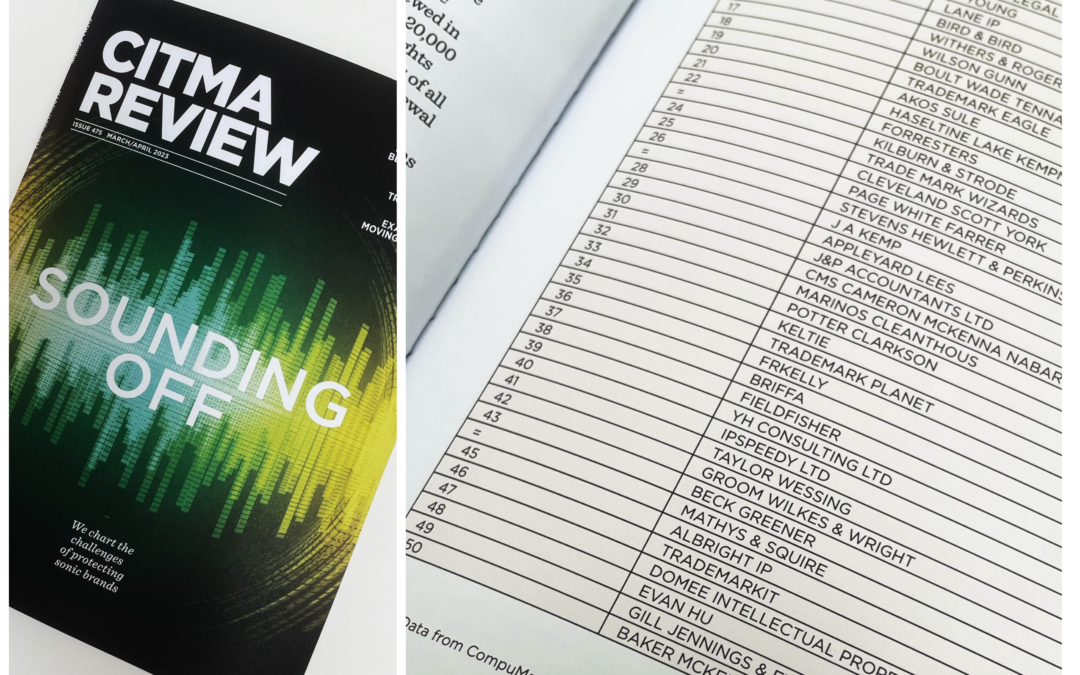
Albright IP is thrilled to announce its inclusion in the annual list of ‘Top 50’ filers of UK Trade Mark Applications, recently published by the Chartered Institute of Trade Mark Attorneys (CITMA). CITMA’s directory lists only the top Trade Mark attorneys in the country, and Albright IP has secured a hard-earned coveted spot at number 45 in the rankings for 2023.

As recognised specialists in the field of Trade Mark law and practice, CITMA members are acknowledged for their in-depth knowledge and expertise. The list represents the very best in the industry.

Albright IP’s impressive ranking in the CITMA list, year on year highlights the team’s hard work, dedication, and expertise in the field of Trade Mark law and practice.

Robert Games, Managing Director at Albright IP, commented on the achievement, saying, “Our continuing ranking by CITMA is testament to the hard work and dedication of our Trade Mark team and showcases our ongoing commitment to providing the highest quality legal services to our clients.”

Established in 2007, Albright IP currently operates with a six-strong Trade Mark team, delivering proactive commercial advice, with great efficiency and a depth of knowledge. The firm has consistently featured in the CITMA annual list, demonstrating the team’s vast knowledge, skills, and capabilities.


ASK AN ATTORNEY


Article Form

Seven registered design disasters, and how to avoid them

student 849825 1920

Registered Designs are probably the least well-known of the Intellectual Property rights, but they can be a powerful and cost-effective tool, if used properly.  A Registered Design protects the appearance of a product, and can be used to prevent competitors from marketing products which produce the same overall impression on an informed user.

Of course, that’s not the whole story.  The devil is in the detail, and there are various factors which need to be taken into account to get the best protection for your designs.  Make sure you don’t fall into any of the traps below!

(This article was first published in 2013, and has now been updated March 2021)

1. You don’t register because “it’s a functional product, so registered designs don’t apply”

It is true that registered designs cannot protect “the way things work” – that is the domain of patents.  Features of the appearance of a product which are “solely dictated by technical function” are excluded from design protection.  However, this is rarely a significant limitation in practice.  A product which does a technical job will look the way it does partly because of that technical job, but there will almost certainly be a “product design” element as well.  If the product could do the same job and look different, even just a bit different, then there is potentially a design to be protected.

It is very rare that the design of a whole product is really “solely dictated by technical function”.  With that in mind, registered designs should be considered for almost any product which somebody is potentially going to look at.

Here are a few examples of registered designs for useful products which have actually been successfully enforced.


4 5 6
Coat hanger Electric skin brush Blind headrail
UK Registered design 2080944

Mainetti v Hangerlogic [2012] EWPCC 42

EU Registered design 000407747-0001

L’Oréal v RN Ventures [2018] EWHC 173 (Pat)

EU Registered design 000361118-0001

Louver-Lite v Harris Parts [2012] EWPCC 53


2. You disclose the design before registering

In the UK and Europe, a twelve month grace period is available for validly registering a design following disclosure.  However, you should not take advantage of this grace period without fully understanding the risks of doing so.

Most other countries around the world do not have a grace period for disclosure.  Unregistered design rights are also rare outside Europe.  By disclosing your design before filing your UK or European Design registration, you potentially destroy any possibility of validly registering your design overseas.

Furthermore, if you launch a product before filing a registered design, and a competitor subsequently launches a similar product (again, before your registration), then no action can be taken unless you can prove that the competitor copied your design.

Where the grace period is relied on, there is a burden on the design owner to establish that they are the creators of their design or a successor in title[1]. This ought not to be particularly onerous if good records have been kept, but nonetheless design owners have sometimes come unstuck on that point.

We don’t say that the grace period should never be used.  For small businesses in particular, deferring the cost of registration until the commercial success of a product has been established can be a valuable option. Reviewing your registrations within the grace period and potentially registering more designs might also be a good idea. However, at the very least you should discuss your plan with an attorney before your product is disclosed.  That way, the best strategy can be developed bearing in mind your requirements for protection at home and overseas and the need to manage your cashflow.

[1] See T-68/10 Sphere Time v OHIM

3. You update the product, but fail to register the newer version

Whether a particular competing product infringes or does not infringe a registered design depends only on whether the allegedly infringing product is or is not too close to the design which has been registered.

It is of course very common for designs of products to go through multiple versions, and almost all products which reach the marketplace will look somewhat different from the picture on the drawing board at the beginning of the design process.

For the best protection, it is vital that registrations are secured for updated versions.  Failing to do this can allow a competitor to release something which is very similar to your product, but different from your registered design.

This pitfall is extremely well illustrated by the high-profile Samsung v Apple[1] case in the Court of Appeal.  Apple relied on a European Registered Design filed back in 2004 – the iPad was not released until 2010.  The problem this caused for Apple was neatly summarised by the Judge in the case, Sir Robin Jacob.

“…this case is all about, and only about, Apple’s registered design and the Samsung products. The registered design is not the same as the design of the iPad. It is quite a lot different. For instance the iPad is a lot thinner, and has noticeably different curves on its sides… Whether the iPad would fall within the scope of protection of the registered design is completely irrelevant. We are not deciding that one way or the other. This case must be decided as if the iPad never existed.”

[1] [2012] EWCA Civ 1339 


1 2 2 3
iPad

(Image credit: Yutaka Tsutano / Flickr)

Apple’s registered design Samsung Tablet 10.1


The lesson is clear – if you want to protect your place in the market, keep your registrations up-to-date!

4. You don’t really consider the scope of protection provided by the registration

In contrast to a patent application, it is not necessary to describe in words what is new about your design, and what protection you are seeking.  But just because you don’t have to write it down, that doesn’t mean you don’t have to think about it!

It’s useful to keep in mind the legal definition of a design that can be protected:

“design” means the appearance of the whole or a part of a product resulting from the features of, in particular, the lines, contours, colours, shape, texture and/or materials of the product itself and/or its ornamentation.

This definition gives a non-exhaustive list of features which might be considered to be part of a design.  It’s worth taking the time to think about each one, and which are the most important in your particular case.

For example, if your product has a new shape and a new surface pattern in a particular colour, then you need to think about what you want to protect.  If you file colour photographs showing the whole product, then potentially a product with the same shape and pattern but in a different colour might not infringe, depending on the importance of the colour to the overall impression.  Almost certainly, a completely different product with the same surface pattern would not infringe – so if you want to protect the pattern, you should consider a registration which does not include the shape of the product at all.  Likewise, a registration covering the shape without the surface pattern is probably advisable.

In the UK you can submit a short written “disclaimer” listing anything shown in the drawings you don’t want to be included. In Europe you can’t, so it is particularly critical to make sure there is nothing in the drawings which you don’t want to limit the scope of protection.

The Magmatic “Trunki” suitcase is a well-known example of a registered design which turned out to be narrower than the owner had hoped. Greyscale CAD renders were registered. The Court of Appeal found it relevant that “each of the representations shows a distinct contrast in colour between the wheels and the strap, on the one hand, and the rest of the suitcase, on the other”. This was “a fairly striking feature of the CRD and it is simply not present in the accused designs”.


Trunki image
Suitcase

EU Registered design 000043427-0001


To be fair to Magmatic, the ”Trunki” design was registered in the early days of the EU design regulation and it is easy to be wise in hindsight.

5. You file inadequate representations

If you file a representation which for some reason is inadmissible, then in most cases your only choices will be either to delete the representation or to lose your filing date.

So before you file, check carefully that all your representations do in fact show views of exactly the same design (i.e. features match in different views).

Also, be mindful of the overall quality of the images you are filing – if they are so poor that the design is not clearly shown, then what you are registering is not a design, just a blur!

6. You forget to renew your UK registration

Since the UK left the European Union EU designs no longer provide coverage in the UK.

However, every owner of an EU design which was in force on 31st December 2020 was given, automatically and for free, an equivalent UK registration.

The UK design has to be renewed separately though – so don’t forget that when the renewal date for your EU design comes round, you need to renew in the UK as well.

7. You file a design without consulting an attorney

Yes, it’s easy to register a design and get a certificate.  But getting good legal protection is more complicated than that.

At Albright IP, we regularly represent clients on both sides of disputes where design infringement is alleged.  We’ve seen the problems which can arise when the registration is filed at the wrong time, showing the wrong product, or showing unimportant features.  We can advise you on exactly what to file to get the best possible protection within your budget.

If you have any questions about registered designs, design patents or IP in general, please contact us via email, by telephone: +44 (0) 1242 691 801, or using the form below and we will be happy to advise and guide you. 


ASK AN EXPERT


Article Form

When To Start Product Manufacturing Part 2

(Research by Alysia Draper)

Robot during product manufacture

Do you have an innovative new product that has been undergoing product manufacturing and development, and that you are now excited to share with the world?

Perhaps you have already produced a prototype and are eager to start manufacturing your product on a large scale. But have you thought about protecting your product and what options are available to you to do so?

Intellectual property (IP) rights are intended to cover this form of protection and include filing a patent application to protect the inventive concept of the product, as well as a design application to protect the visual appearance of the product. The inventive concept of the product outlines the ways in which the product differs technically to similar products already available on the market today.

This article is split into two parts: Part 1 discusses patent applications and Part 2 discusses design applications. Both articles aim to identify:

  •  How to avoid disclosing your invention to the public and why it is important to avoid doing this.
  • When to consider IP in regard to your invention.
  • When to file a patent and a design application, and which order the applications should be filed.
  • The options available if you change the underlying idea for your invention.

So, when do I start the product manufacturing process? The answer to that question first requires a basic understanding of patent protection, because the two things (product manufacture and patent protection) are intrinsically interlinked.

Part 2 – Design Applications

AlbrightIP Design Process Diagram Design V1


The aim of filing a design application is to protect the ‘look’ of the final product before the public launch of the product. Once the design application is filed, amending the submitted drawings is not possible. If you amend the visual aspect of your product, the filed design application will no longer protect your new product and you will therefore need to file a new design application. This second filing will have a later filing date and therefore the timeline of a design application starts from the beginning again.

There is a common notion that a design registration is a ‘poor man’s patent’, being cheaper and easier to obtain. Many people opt to file a design application, knowing that in the U.K. there is a 12 month grace period following the first disclosure of the product where the applicant can validly file a design application. The designer, owner of the design or an authorised individual is allowed to disclose the design in this period.  This means that the visual aspects of your product can be disclosed and a design application can be safely filed later in the U.K.

Therefore, we would advise only filing a design application once the final product is clear in your mind: if the final product is not ready then it would be best to wait to file a design application until the product is finalised.

AlbrightIP Design Process Diagrams Figure1 Updated V1


As a reminder from Part 1, if a design application is filed before a patent application is filed, the design application could disclose the invention. As patent applications do not have a grace period for disclosure in the UK, you have to ensure that a patent application is filed before the design application. This is shown visually in Figure 1.

We therefore advise against disclosing the invention before filing a patent and/or a design application, however the possibility of using the 12 month disclosure period before filing a design application gives you time to observe the reaction from the public before you file. If the response is negative, then you know that you need to change the design.

In conclusion, it is best to wait until both the patent and design applications are filed before the product manufacture process. This could save you time and money as you will be confident that the manufacture of the invention is worthwhile as the invention is suitably protected.

Summary

In this article we have concluded the following points:

  • A design application can be filed to protect the visual aspect of your invention and we advise filing this after filing a patent application to avoid disclosing the invention unintentionally.
  • IP should be considered before starting the large-scale production for your invention as this will prevent you wasting large amounts of money on an invention that may already be disclosed.

If you would like to talk to an expert in product design, Duku is our sister company and works closely with the attorneys at Albright IP. Duku is a high-quality and efficient product design company; you can browse the projects they have been involved in at https://www.duku.co.uk/. If you are interested in filing a design application and/or a patent application with Albright IP, and need assistance with the product design process, then the team at Duku will be happy to help.


If you have any patent, design or trade mark queries, please contact us via email, by telephone: +44 (0) 1242 691 801, or using the form below and we will be happy to advise and guide you. 

ASK AN ATTORNEY


Article Form


When To Start Product Manufacturing Part 1

(Research by Alysia Draper)

Robot during product manufacture

Do you have an innovative new product that has been undergoing product manufacturing and development, and that you are now excited to share with the world?

Perhaps you have already produced a prototype and are eager to start manufacturing your product on a large scale. But have you thought about protecting your product and what options are available to you to do so?

Intellectual property (IP) rights are intended to cover this form of protection and include filing a patent application to protect the inventive concept of the product, as well as a design application to protect the visual appearance of the product. The inventive concept of the product outlines the ways in which the product differs technically to similar products already available on the market today.

This article is split into two parts: Part 1 discusses patent applications and Part 2 discusses design applications. Both articles aim to identify:

  •  How to avoid disclosing your invention to the public and why it is important to avoid doing this.
  • When to consider IP in regard to your invention.
  • When to file a patent and a design application, and which order the applications should be filed.
  • The options available if you change the underlying idea for your invention.

So, when do I start the product manufacturing process? The answer to that question first requires a basic understanding of patent protection, because the two things (product manufacture and patent protection) are intrinsically interlinked.

Part 1 – Patent Applications

British Patent Application Timeline

Typical timeline for a Patent Application in the UK from start to grant

How to Avoid Disclosing Your Invention Before Filing a Patent Application

An invention can be disclosed in a number of ways, from purposely advertising the invention online or even through unintentionally posting about the invention on your social media.

The easy answer here is to avoid disclosing your invention at all until your intellectual property rights (a patent application and/or a design registration) are safely filed. The general rule of thumb which will always keep you safe is to keep the invention under wraps, and fully launch the product only after applying for legal protection.

Be aware that a design registration (also called a ‘design patent’ in the USA) protects the exterior ‘look’ of a product. It does not protect the function of the product. To protect the clever function or the technical improvement, irrespective of how the product actually looks to the consumer, then that is what a patent is for.

It is also worth bearing in mind that a design registration and a patent application work together, and it is often the case that both will be required for a new and innovative product.

But, what happens if I file a design registration to the ‘look’ of my product, before I then file a patent application? It is critical to remember that a design application will often publish very quickly. If your invention or development is disclosed by filing the design application first, it is highly likely that you will not be able to achieve a granted patent following that disclosure. Therefore, an important consideration when one files a design application is that you could be disclosing the invention before a patent application is filed.  This example is outlined in Figure 1.

AlbrightIP Design Process Diagrams Figure1 Updated V1

Although a marketing team may want to gauge customer interest by advertising the product, it is critical that this is avoided prior to filing your patent rights. As mentioned above, although in the UK a design application allows disclosure up to 12 months before filing (but remember this is not the same in all territories around the world!), disclosure before filing a patent application is not as lenient and will invalidate your rights. Just to reiterate the point above, the safest rule is to file first before any disclosure.

Once a patent application is filed, the invention can be disclosed. The patent application will automatically become available to the public, and therefore publicly disclosed at 18 months after filing the application, unless it is a requirement to remain a secret.

If you need to disclose the invention, for example you need a product designer’s opinion to see whether it is possible to produce the invention, or for financial reasons, a non-disclosure agreement (NDA) should be used. This is a contract binding the parties to confidence. You can be assured that all regulated patent attorney firms are required to keep the information about your invention confidential. Therefore, an NDA is not required with a qualified, chartered and regulated patent attorney.

Our advice for filing a patent application to avoid any difficulties is simple: ensure that you have a concrete idea of what the final product will be and then file the patent application as soon as possible; ideally before the product manufacturing process. Once the patent application is filed, then the filing of a design application can be considered in preparation for the launch of the final product.

Why Should IP Protection be Considered Early?

Figure 2 below outlines an example of a scenario if IP protection is not considered early. For clarity purposes, let’s say that you, the reader, are Company A and you have invented product X. Company B has the same brainwave as you and immediately files a patent application for product X.

Figure 2 - Why file patent application early

Figure 2 – Why file patent application early

If applying for a patent application is left too long, then there is no guarantee that the inventive concept will be protected if another company files a patent application covering the same subject matter. The inventive subject matter to be protected is outlined in the claims of the patent application.

When a patent application is filed, the invention benefits from a ‘patent pending’ status. Having a ‘patent pending’ status provides the application with ‘provisional protection’. This so-called ‘provisional protection’ period is active between the publication of the patent application up until the grant of the patent application. If an infringing act is undertaken by another party in the ‘provisional protection’ period, the applicant may be able to collect retrospective damages.

Even if the original company, in this case Company A, invented product X, it would be a huge risk to continue making, disposing of, using, importing or keeping the product as these would constitute infringing acts. See our section on patent infringement. Therefore, the importance of filing a patent application early is clear.

Before a patent application is filed, or product manufacturing has begun, it is advised that due diligence is carried out. This involves conducting a search to check if any IP rights already exist and, therefore, if there is a risk of infringement before the launch of your product.

In Figure 3, we are using the examples of Company A and Company B once more. Again, let’s imagine that Company A is you, the reader.

Figure 3 - The disclosure pitfall

Figure 3 – The disclosure pitfall

As explored in Figure 3, potential disclosure of the invention is another important aspect to consider. Company A has dreamt up an invention X, but it just so happens that another party, Company B, also has the same idea and puts it onto their weekly newsletter which is sent to their database of 500 customers. Even if Company B doesn’t file a patent application, they have still publicly disclosed the invention to their customer database via their newsletter. While Company A could file a patent application, the prior disclosure by Company B would prevent the application from being granted even if Company A came up with the invention in the first place.

These examples are why considering IP protection early in the development process is a priority. Doing so could save you valuable time and money over the longer run.

What if You Want to Change the Product After Filing?

Let’s assume that the suggestion to file an initial patent application early on to protect the broad concept prior to serious product design, prototyping and manufacture has been undertaken. What if you or the product design team comes up with further features for the invention during the development and testing phases?

It is important to note that there is a 12-month period following the first filing of a patent application in which you can file a second or an updated patent application. The second patent application can claim the same filing date as the first application for the original material, but the second application can incorporate further or new features of the invention, provided those further features have not already been made public.

The first patent application includes:

– A broad outline of your invention. – Specifics of the current features, including caveats which may cover some versions of the product which may be manufactured by you (or your competitors) in the future.

During the next 12 months after filing the first patent application (assuming this is at the UK Intellectual Property Office), a search report will be issued for the first application. This is a report with basic analytics which outlines any documents or products that could be similar to your own invention. The search report can provide a potential direction for how to develop the invention in the first application further.

Alternatively, if you want to change your product slightly after the first application, you can decide to file a further updated patent application.

This second application builds on the claims and description of the first application and can claim the filing date of the first application, as long as a second application is filed within 12 months of the first application. Any new material in common to both applications will be backdated to the filing date of the first application. However, new features cannot be backdated.

If, however, the inventive concept of the product has deviated significantly from your original application and the aspects of the invention are not supported by the original application, then a new patent application will need to be drafted directed to the new concept.

If you are still figuring out the main concept of your product, then it is best to have a fully formed idea, than something incredibly broad, i.e. if you are not completely sure what the product is trying to achieve. At this point, we will not be able to fully visualise the invention, if the concept itself is vague and drafting a patent application may be difficult.

Therefore, before manufacturing of the invention is considered, you must envisage what the final product will be before you can effectively think about the IP side of things. This will prevent you putting substantial amounts of time and money into the manufacture of products that, in the end, you might not be able to sell.

Summary

In this Part 1 article we have concluded the following points:

  • Once you have a finalised product, we strongly recommend that you first file a patent application covering the inventive aspects or technical improvements before you disclose the invention to the public or begin product manufacture.
  • IP should be considered before starting large-scale production of your invention, as this will prevent wasting large amounts of money on an invention that may already be disclosed.
  • If you decide to change your product after filing a first application, there is an option to file a second application covering the new aspects of the invention, provided the second application is filed within 12 months of the first application.

If you would like to talk to an expert in product design, Duku is our sister company and works closely with the attorneys at Albright IP. Duku is a high-quality and efficient product design company; you can browse the projects they have been involved in at https://www.duku.co.uk/. If you are interested in filing a design application and/or a patent application with Albright IP, and need assistance with the product design process, then the team at Duku will be happy to help.

If you have any patent, design or trade mark queries, please contact us via email, by telephone: +44 (0) 1242 691 801, or using the form below and we will be happy to advise and guide you. 

ASK AN EXPERT


Article Form


Albright IP Celebrates Exam Hat-Trick

Three successful exam graduates outside Albright IP

We’re celebrating after three of our employees chalked up big successes in their exams just recently.

Both Lauren Fisher and Zainab Rhyman, who are on the pathway towards qualifying as Trade Mark attorneys, scored highly in the 2022 CITMA Paralegal exams, with Lauren attaining the highest mark of the cohort, with an impressive 98/100!

The Institute-led CITMA Paralegal course provides extensive grounding in a variety of topics, including the technical skills associated with the management of Trade Mark registrations, searches, renewals and maintenance, changes of ownership, oppositions, Trademark infringement, and cancellations.

It also touches on registered designs and domain names, ensuring that candidates complete the course with a full understanding of professional practice.

At the same time, Joel Weston has passed his final CITMA exams with a Distinction, and is now a fully qualified Trade Mark Attorney, soon to be Chartered.

“It’s really important to us to support our people in their career development and provide an environment in which they can thrive and grow,” said Albright IP Managing Director Robert Games. “We’re very proud of Lauren, Zainab and Joel – they’ve worked so hard for their achievements and it’s great to see their dedication rewarded.”

Top-score Lauren graduated from the University of Nottingham in 2021 with a First-Class honours degree in Law (LLB), before joining Albright IP as a Trade Mark Paralegal in July 2021. Starting her career with Albright IP at a similar time, Zainab a law graduate who graduated from the University of Bristol in 2021.

Lauren and Zainab will both be enrolling on to the first part of their professional training towards becoming Trade Mark Attorneys in the Autumn of 2022.

Joel Weston graduated from the University of Wolverhampton in 2015 with a First-Class Law degree (LLB), and went on to obtain a Commercial Law Master’s degree (LLM) at the University of Bristol in 2016. He joined Albright IP in March 2019 as a Trade Mark Attorney trainee, and since then, has become a highly regarded member of the team, involved in all aspects of Trade Mark prosecution and enforcement. His qualification as a Trade Mark Attorney, includes a Litigators Certificate.

If you have any patent, design or trade mark queries, please contact us via email, by telephone: +44 (0) 1242 691 801, or using the form below and we will be happy to advise and guide you. 

ASK AN EXPERT


Article Form


M&S allegin’ design infringement – Aldi sparks new row

‘Tis the season to be jolly, but Marks and Spencer (M&S) is none too happy about Aldi’s two new gin product designs. Whilst Aldi’s Twitter team has been making light of it with some tongue-in-cheek tweets, M&S believes that Aldi has infringed some of its UK registered designs and has commenced legal action. bubbles gf258a373d 1920 1024x683 1

From caterpillar cake to glittering gin

M&S and Aldi have previous in the legal arena, having locked horns (or perhaps antennae?) earlier in 2021 over their respective caterpillar cakes. However, that particular fight was over trade mark rights. This time round, M&S is relying on its registered design rights. M&S originally filed for a series of ten EU registered designs in December 2020 (pre-Brexit). This was after they had launched their products. For many territories, including China, this destroys the chance to obtain registered design protection. Wherever possible, file first and launch later. M&S then followed up with a series of ten UK registered design rights (post-Brexit). M&S deliberately filed separately in the UK as opposed to allowing the UK Intellectual Property Office to ‘clone’ their EU designs. This was presumably done to maximise the length of UK design protection (i.e. they can still have the registered designs in force in the UK in the run-up to Christmas 2045 – save the date). Two of the designs relate to silhouetted decorations, whilst the other eight show variations of light-up bell-shaped gin bottles. Or in other words… Gin-gle bells.

Courting controversy

Aldi isn’t exactly known for treading gingerly when it comes to the thorny issue of copying. They have plenty of copycat products from “Jammy Wheels” (née Dodgers) to “Cheese Puffs” (a.k.a. Wotsits), amongst many others. Whilst similar to well-known brands, there isn’t necessarily any confusion over the origin of the products, so Aldi can walk the line between what is and isn’t an infringement of someone else’s rights. However, flirting with branding is a different ball game to that of registered designs. There doesn’t need to be any confusion or misrepresentation about the origin of a particular product where registered designs are concerned. It’s about whether the infringing product looks too similar to the registered design – is the “overall impression” the same or different in the eyes of the “informed user”? N.B. Not as easy to predict as you might think – try our registered designs quiz to see how your judgment fares in relation to some past design decisions.

Borderline by [M&S] design

Whilst Aldi probably put some careful thought into their product designs, M&S clearly considers that the overall impression is too similar for their liking. That’s not to say that there aren’t any other copycat products out there, but comparatively speaking they are probably small fry whereas it seems clear that M&S wants to nip Aldi’s latest move in the bud. After all, Aldi’s products launched in early November 2021 and things have already ended up in the High Court. Five of M&S’ registered designs form the basis for their legal action against Aldi:

Picture1 This registered design is for the decorative wraparound on M&S’ Christmas gin bottles. Or in M&S’ words: “a winter forest silhouette graphic design”. Note that the trees and animals are dark on a light background – the UK Supreme Court previously confirmed in the Trunki case that colour contrast is a feature of a registered design unless disclaimed (and there doesn’t appear to be any disclaimer in this case).

Picture2 1Picture3 1 This registered design shows M&S’ Christmas gin bottle with gold flakes settled at the base (although that’s not especially clear since these are the only two views in the registration). The right-hand view seems to clearly be illuminated at the bottom, but it’s less clear for the left-hand view. The base doesn’t have the same glow as the right-hand view, but the meniscus region seems to be illuminated in both images. Note that the appearance of the cork is part of the design, as is the shape of the bottle, as is the silhouette design which extends all the way round the back (the curvature of the glass distorts the rear trees in the right-hand image). It is also worth noting that the silhouette appears to be somewhat grey in the foreground – the court papers from M&S say it’s white, but it doesn’t really look white here – and somewhat darker in the background, which is again part of the registered design since there is no disclaimer.

Picture4 1 Picture5 1This registered design is similar to (2) above, except that the gold flakes have been suspended in the gin against a light backdrop. This means that the flakes obscure some of the rear silhouette, contributing to a different overall impression relative to (2). The undersides of the flakes are illuminated in both views, suggesting that the light in the base is on for both views.

The bottle here is similar to (2), but with a white cork and set against a darker background. The left-hand image seems to be illuminated whilst the right-hand one isn’t (but is presumably lit up from being in a lightbox for the photograph). There is a silver/gold contrast between the silhouetted scenes on the two images, which is again part of the design. The gold flakes are again settled at the base. Picture7Picture6 1 It’s also worth noting that reflections from the lightbox are clearly visible on the glass and haven’t been disclaimed, so technically the reflections are part of the design. It’s much more apparent here relative to (2) and (3) because of the darker backdrop.

Picture8 Picture9This registered design is similar to (4) above, except that the gold flakes have been suspended in the gin against a dark backdrop. Like in (3), this means that the flakes obscure some of the rear silhouette, contributing to the different overall impression relative to (4). The undersides of the flakes are illuminated in both views, suggesting that the light in the base is on for both views. Reflections from the lightbox are again visible on the glass and haven’t been disclaimed, so technically from part of the design. The black and gold elements in this design are particularly eye-catching. Picture10Picture11 Then there are the two Aldi gins that M&S alleges fall within the scope of those registered designs: These images only seem to show non-lit versions of the Aldi products with flakes suspended in the gin. Aldi is probably of the opinion that the two-tone tree/ground silhouettes, the lack of animal silhouettes, the different colour contrasts, the different silhouette perspective (pseudo-3D instead of 2D) and the strikingly white portions of external appearance of the silhouette portions all contribute to providing a different overall impression to the M&S registered designs. Do either of Aldi’s gin products infringe M&S’ registered designs? (M&S doesn’t appear to be relying on unregistered design rights at this point) It’s reasonable to think that at least one of the parties is going to try demonstrating the illumination in each product to argue their case. How the light interplays with the gold flakes and silhouettes forms a significant part of the overall impression, and it is difficult to judge without seeing how they look when lit up. Based on the bottle images at hand, the M&S design silhouettes are comparatively darker than those of the Aldi designs, and this provides a noticeably different colour contrast. Perhaps the ‘white’ wraparound decoration on M&S’ designs isn’t entirely true to what M&S actually wanted to protect? It is worth remembering that it is what is shown in the registered designs that counts for registered design infringement – not what the M&S products look like. Novelty and individual character are also important, as is ‘design freedom’ i.e. what previous designs for light-up bottles with gold flakes in the liquid were available before 15 December 2020 (when M&S’ original EU designs were filed)? If there were few to none, then M&S may successfully argue for a wider degree of design freedom. That is, design infringement is more likely if light-up bottles with gold flakes in them were brand new at the time of filing.

The benefit of hindsight

  If M&S had had a crystal ball in addition to their light-up gin snow-globe bottles, could they have obtained registered design protection which made it harder for Aldi (or anyone else) to attempt to design around their registered designs? Leave out the animal elements of the silhouette portion, disclaim the neck region of the bottle, convey the white colour of the silhouettes a bit more clearly… and the registered designs of the gin bottles are arguably closer to catching the Aldi products. It would have been impractical to protect a large enough number of design variations to cover all eventualities. But then again UK registered designs can be filed at comparatively low cost and some additional designs focussing on the trees / snowy landscape could (with hindsight) have provided some extra options for enforcement. Another important point is that the registered designs relate to the 2020 versions of M&S’ Christmas gin products. The M&S Christmas gin products in the 2021 range look different. Have they filed new design applications to protect the latest versions of their products? If not, then it may weaken M&S’ overall position – see point (3) of our article on seven registered design disasters and how to avoid them. Apart from registered designs, could M&S have patented their light-up bottle? The process is more drawn out and the prospects of grant are less certain, but the scope of protection afforded can be considerably broader than a registered design (and useful for Patent Box tax relief too). At the time of writing, it’s possible that M&S did file a patent application and it just hasn’t published yet.

Success by registered design?

It’s too early to say how M&S will fare in their latest legal dispute with Aldi. The wheels of justice tend to turn relatively slowly and it will take some time for the court action to work its way through the system. In the meantime, M&S might kiss and make up with Aldi under the mistletoe before a trial commences, but after the Colin v Cuthbert caterpillar contest (and all of Aldi’s jibes on Twitter) M&S could be intent on pursuing the claim as a matter of principle. Given that the designs in question are for Christmas gin products, potential damages or an account of profits will probably be limited to sales in the festive season. Is it really worth pursuing a costly legal claim when there is a fairly short window of time for potentially infringing sales? Principles aside, the answer could well be yes. If M&S win, not only might it serve to scare off other possible infringers in the UK, but if M&S ends up dissuading Aldi from selling copycats of future M&S products then drawing a line in the sand now could reap dividends in the long run. It also might also make others think twice about launching similar products in the EU. The premium British innovator versus the budget German disrupter… It will be intriguing to see which side wins out in the end this time.

Patenting Apple’s Siri Software in Europe

Patenting Apple Siri Software in EuropeCase Study No. 3

Index

INTRODUCTION

This third Software Patent Case Study follows on from my earlier First and Second Case Studies analysing how to patent software in Europe.

Below, we will dissect a recent European software patent awarded to Apple Inc which covers some of the specific functions of Apple’s Virtual Assistant, Siri® to see exactly how Apple got this patent allowed.

As with Amazon’s Alexa® and Google’s Assistant, the home speaker and virtual assistant market is likely to grow exponentially in the coming years. It will therefore become increasingly valuable as we become more connected and more reliant on this technology, which will improve with the faster network speeds of 5G and then 6G also becoming the norm.

Unsurprisingly, therefore, the tech-giants need to protect their development work, and patent protecting the operation of their individual virtual assistants is a priority.

As with the earlier articles in this Case Study series, it is a common misconception that ‘software’ cannot be patented in Europe. As with many technical developments, there are always likely to be hurdles to overcome, but knowing the general strategies that result in successful grant of software patents in Europe allows for consideration and review at the outset, along with a plan for success to be formulated.

So, let’s take a look at this recently granted European patent EP3453019, which Apple secured and which is titled: ‘Intelligent List Reading’.

Can you really patent protect ‘intelligent list reading’? The answer is yes!


SOFTWARE PATENT CLASSIFICATIONS

As with the earlier patents analysed in this series of articles, this patent was classified in some of the ‘G06F’ classifications relating to ‘information retrieval; database structures therefor; file system structures therefor’, and ‘G10L’ classifications relating to ‘speech recognition’. See the following graphic from the front page of the patent:

Patent Classification


EXAMPLE SEARCH RESULTS FOR SOFTWARE PATENTS

If you are interested in looking at what else appears in these Classifications, see the following links – you will be amazed at what is being submitted, by which companies, and what is being granted.

Remember, ‘G06F’ is a broad Classification term, and we can drill down further into this Code to refine our searches (such as G06F3/16 or G06F16/33 as shown in the above graphic).

Similarly, ‘G10L’ is a broad term, and likewise can be refined (such as G10L 15/22 and G10L 15/18 as shown above).

Starting with G06F search examples:

  • Classification search results using ‘G06F’ worldwide (i.e. including Europe, the USA, China, and so on): Click here
  • Classification search results using ‘G06F’ for Europe only: Click here
  • Classification search results using ‘G06F’ for Europe only and only which are granted: Click here

And now for G10L search examples:

  • Classification search results using ‘G10L’ worldwide (i.e. including Europe, the USA, China, and so on): Click here
  •  Classification search results using ‘G10L’ for Europe only: Click here
  • Classification search results using ‘G10L’ for Europe only and only which are granted: Click here


WHAT PATENT IMAGES DO WE NEED?

This is a very common question, and Figure 1 in Apple’s EP’019 patent provides a nice example of what we need to show to the Patent Examiners. This first image provides a high-level overview of the possible system.

Do take particular note of the end user, shown at the bottom left, the user interface (referenced as 104, for example, a smartphone or tablet), and then a second user interface or second screen 122, both of which interface with a cloud computing network.

The cloud computing network then interfaces with the remote backend hardware and software architecture, shown in a broad block-diagram manner:

Figure 1

This type of Figure 1 diagram is a nice way to ease the Patent Examiner into the subject of the patent.

By showing the hardware items, we are aiming to convince the Examiner that the focus of the patent is not purely relating to ‘software’ alone, which may cause patentability issues due to software on its own being excluded under patent law.

Next, we have Figure 2A, shown below.

Although this Figure 2A looks complex, it is actually just showing you the iPhone® or similar device (user device 104 shown in Figure 1 above), and how the circuitry and processing modules communicate.

Again, we are easing the Examiner into the detail, and persuading her that this relates to ‘technical’ matter and not solely software:

Figure 2A

The subsequent drawings all follow the same idea. It is not until Figure 7A that ‘Siri’ the personal digital assistant is actually properly introduced as a generalised block diagram with ‘hardware’ type language – again trying to steer away from purely software terms:

Figure 7A

Figures 8A onwards then introduce the algorithmic processes, broken easily into generalised logic steps, which allow Siri to function:

Figure 8A

And, wrapping it all up, Figures 9A onwards give the Examiner an ‘in use’ example of Siri in action, using the previously presented device, system, and algorithms:

Figure 9A


SUMMARY OF THE REQUIRED PATENT IMAGES

So, in summary, providing the Patent Examiner with the following general categories of patent diagrams in a ‘software’ patent is an excellent starting point:

  1. High-level backend architectural framework of the overall system;
  2. A more focussed generalised view of the backend hardware of the end-user device;
  3. The algorithmic processing/method steps of the software, how the data moves, and the logic flow paths;
  4. One or more examples showing the novel system in action.


THE FORMAT FOR ALLOWABLE SOFTWARE CLAIMS

To successfully patent software concepts in Europe, the general formula to start with is along the lines of:

Main Claim 1 – outline in technical language the methodology, algorithmic steps, and/or backend processes that are taking place by use of the software combined with the hardware infrastructure to achieve the end result;

Main Claim 2 – cover the methodology of claim 1 via ‘non-transitory computer readable medium’ language;

Main Claim 3 – cover the hardware system itself which implements the Main Claim 1 methodology;

Main Claim 4 – cover a physical electronic device (i.e. an iPhone®) utilising the methodology of Main Claim 1.

Lets now take a look at each of these Main Claims, as granted in Apple’s European software patent EP’019.

Focussing firstly on Main Claim 1, this details the data processing steps.

Note (highlighted with red circles) where ‘hardware’ type terms are used, but which actually represent data items, and thus is actually software related but deemed patentable language:

Main Claim 1

Main Claim 2, which in this EP’019 patent is numbered as claim 30, then covers the computer memory having code thereon to implement the method of Main Claim 1:

Main Claim 2

Main Claim 3, which in this case is numbered as claim 32, recites the overall ‘system’, having the hardware features, being processors, along with the memory of Main Claim 2 (claim 31 above):

Main Claim 3

Finally, Main Claim 4, which in this case is numbered as claim 34, covers an actual physical device, such as the iPhone®, having various hardware components which interact with each other in some form.

Note that the ‘processing unit’ in this Main Claim 4 (claim 34) is an item of hardware, but essentially repeats the algorithmic processing steps of Main Claim 1:

Main Claim 4

By submitting the Main Claims in these forms, the European Examiner had no issue accepting that the monopoly being requested was related to technical matter, and thus not solely excluded software matter. The first potentially problematic hurdle was overcome.


SUMMARY OF THE FORMAT FOR ALLOWABLE SOFTWARE CLAIMS

So, in summary, providing the Patent Examiner with the following general categories of patent claims in a ‘software’ patent is an excellent starting point:

  1. A method of operation;
  2. A memory having code thereon to implement the method;
  3. A system having one or more processors, and a memory with code to implement the method of operation;
  4. An electronic device having hardware items configured to implement the method.


WHAT HAPPENED DURING PATENT EXAMINATION?

Wrapping up this analysis, by Apple submitting its claim set in the above form allowed them to overcome the first of three hurdles to grant.

The first hurdle considered by any Patent Examiner is: ‘Is the subject matter excluded under the patent law?’

In Europe, one of these exclusions is if the ‘invention’ is purely software, then it is not technical, and thus is it not grantable as a patent.

The above claim language, using physical hardware type terminology conveys to the Examiner that the invention being claimed in more than only software. It is therefore seen as being technical in nature, and no objection is raised in terms of excluded subject matter.

The Examiner then moves on to the second and third hurdles to grant, which are novelty and inventive step.

For this EP’019 patent, the Examiner objected to the novelty (uniqueness) of the original claim language shown above in view of two earlier patent documents (US’274 and US’013).

Apple counter-argued along with submitting minor revisions, shown below (additions made by Apple shown underlined, deletions crossed through).

This satisfied the Examiner. It was accepted that there was a sufficient technical and cleverly unique distinction, and the patent was granted.

Granted Main Claim 1:

Granted Main Claim 1

Granted Main Claim 2 (finally renumbered as claim 12):

Granted Main Claim 2

Granted Main Claim 3 (finally renumbered as claim 13):

Granted Main Claim 3

You will note that Apple decided to reduce the number of their claims during examination, and interestingly decided to remove their ‘system’ claim.


WRAPPING IT ALL UP

For successfully patenting software in Europe, focus on the following:

  1. The patent drawings – provide a high-level overview of the system frame work and any relevant user device as generalised block diagrams, logic YES/NO flow charts showing the processing steps, and some in-use examples; and
  2. The categories of patent claims – provide a method of operation; memory having the code; a system using the memory; and a device having hardware to implement the method.


If you would like further information, please contact us via email, by telephone: +44 (0) 1242 691 801, or using the form below and we will be happy to advise and guide.


ASK AN EXPERT


Article Form

Is A Twelve Month Patent Grace Period Coming To The UK?

Is A Twelve Month Patent Grace Period Coming To The UK

The general rule of thumb for all of your intellectual property (IP), which includes patents, designs, trade marks, and copyright, is to secure your legal rights first before you disclose to anyone else. Certainly in terms of validity, this rule should always keep you safe both in your home market and overseas.

But, some countries do ‘mix and match’. In particular and contrary to the above rule of thumb, some countries do allow inventions to be publicly disclosed before a patent application is filed to secure those legal rights to the idea.

Currently for patents, the UK is not one of those countries. But could things be about to change?

Since leaving the EU, the UK has been attempting to secure beneficial trade agreements with various countries around the world. One of the routes by which the UK is pursuing this is by application to join the Comprehensive and Progressive Agreement for Trans-Pacific Partnership (CPTPP). This is a free trade area which has 11 signatories including Australia, Canada, Japan and Singapore.

However, joining this Pacific free trade agreement could cause a major patenting headache for the UK.

Article 18.38 of the Intellectual Property clauses of the CPTPP  requires members to have a 12-month grace period for patents. This is to permit inventors to disclose or publish their invention up to 12 months before filing for a patent application.

The UK does not presently have a 12-month patent grace period, instead having only relatively weak six-month grace periods for abusive disclosures or disclosures made at a designated international exhibition.

What does this mean for disclosure?

So generally speaking, in the UK if an inventor discloses their invention before filing a patent application, then the patent application would be refused, or any resulting patent would technically be invalid.

If joining the CPTPP, the UK would apparently need to change this so that the inventor could publish their invention up to 12 months before filing a patent application.

A strong 12-month grace period would provide advantages to UK inventors. This is particularly the case for non-patent-savvy individual inventors and SMEs who might not realise that disclosing their invention can preclude them from obtaining a patent. At Albright IP we receive plenty of calls from inventors in such a situation. It would also be beneficial to academic researchers, who may publish their scientific results before seeking patenting advice.

Additionally, the US has a strong 12-month grace period. Harmonising grace period rules with the US could make it easier for US businesses to protect their inventions in the UK, potentially encouraging more US business and investment in the UK.  US companies already file the most UK patent applications of all foreign companies (2,151 UK patent applications were filed in 2019 by US companies – the next highest was 775 UK patent applications filed by Chinese companies). So, such harmonisation would be logical from this point of view.

What about the EU?

However, the UK implementing a grace period could cause complications and issues for UK inventors and companies. Since not all territories have a grace period, if a UK inventor were to rely on the prospective UK grace period, they may have unwittingly prevented themselves from obtaining protection in other territories, for example in Europe.

Indeed, the UK’s current grace period provision mirrors that of the European Patent Convention. The European Patent Convention governs the European Patent Organisation (EPO), of which the UK is a key member. European patents (with their relatively weak grace period provisions) account for a substantial portion of the patents which cover the UK.

It seems unlikely that the UK changing its legislation to provide a robust 12-month domestic patent grace period would result in automatic ejection from the EPO (EPO member state Turkey has a 12-month domestic grace period so clearly different grace periods can coexist within EPO member state).

However, having two different kinds of patents in force in the UK (EPO originating patents with the weak six-month grace period and UK originating patents with the strong 12-month grace period) would be a complication and add confusion for patentees and potential infringers.

So, there is a possible conflict between the UK’s present membership of the EPO, and its proposed membership of CPTPP.

To avoid this, the UK would need to leave the EPO/EPC, convince the EPO/EPC to also introduce a 12-month grace period, or just join CPTPP and not implement a 12-month grace period and hope that nobody notices.

The last of these may be worth attempting to minimise disruption – CPTPP signatory Japan, for example, still only has a 6-month grace period, which is contrary to the CPTPP.

But, the UK would miss out on those positives of the 12-month grace period.

The boldest move would be for the UK to leave the EPO/EPC and forge ahead with a strong 12-month grace period, attempting to form closer patenting ties with other 12-month grace period countries, such as the US and Australia.

This would cause a great deal of disruption to the UK patenting sector (the full discussion of which is outside the scope of this article), and would cause confusion for UK inventors.  Although the UK government has previously stated its commitment to the EPO/EPC, they would not appear afraid of a U-turn. This possible change in direction would seem to align with the UK government’s current pro-global post-Brexit vision.

There would appear to be no easy answer here and it seems that the UK will create some patenting disruption or uncertainty by joining the CPTPP.

Nevertheless, at Albright IP we will be able to advise and guide you on your best course of action, whatever the situation.

If you have any patent, design or trade mark queries, please contact us via email, by telephone: +44 (0) 1242 691 801, or using the form below and we will be happy to advise and guide you. 


ASK AN EXPERT


Article Form